
The Clinical & Metabolic Science of Creatine: A Biomechanics & Bioenergetic Deep Dive
While often marketed simply as a muscle builder, Creatine is a vital endogenous compound in human bioenergetics. It is, by definition, one of the most clinically-verified compounds on earth, with over 1,000 peer-reviewed trials supporting its safety and efficacy for both performance and pathological conditions.
To use creatine effectively is to understand the metabolic logic of the human cell.
1. The Endogenous Synthesis Path
Before we discuss supplementation, we must understand how the body creates creatine. Creatine is synthesized primarily in the liver, with smaller amounts produced by the kidneys and pancreas.
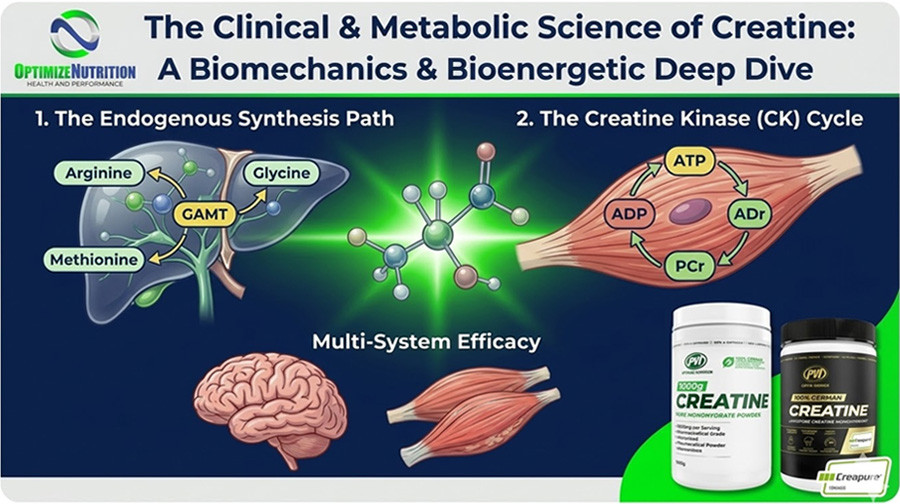
It is made from three specific amino acids: arginine, glycine, and methionine. Synthesis is a two-step process involving the GAMT (Guanidinoacetate methyltransferase) pathway. If GAMT deficiencies exist, or if the body lacks pre-cursor amino acids (specifically methionine, a bottleneck), endogenous synthesis is severely limited.
A healthy individual on a standard diet can maintain a "pool" of about 120g of creatine, 95% of which is stored in skeletal muscle.
[Image suggestion for image_0.png: A scientific diagram showing the Gam-T metabolic pathway in the liver where creatine is created from Arginine, Glycine, and Methionine, compared to exogenous uptake.]
2. The Creatine Kinase (CK) and ATP/PCr Energy Cycle
The core function of creatine is in the re-phosphorylation of ATP (Adenosine Triphosphate), the primary energy currency of the cell.
When a muscle contracts intensely, it converts ATP into ADP (Adenosine Diphosphate). A cell can only hold enough raw ATP for 2–3 seconds of intense work. To maintain contraction, ADP must be recycled back to ATP instantly.
Here is the precise metabolic cascade:
- Creatine is stored in the muscle as Phosphocreatine (PCr).
- The Creatine Kinase (CK) enzyme catalyzes a reaction where PCr donates its phosphate molecule directly to ADP.
- Result: The cell is flooded with "fresh" ATP within milliseconds, enabling intense bursts of contraction (roughly 8–12 seconds of peak output).
3. Exogenous Uptake, "Saturation," and "Loading"
Why do we supplement? Exogenous creatine is absorbed from the diet (red meat, fish) but is unstable and only found in small concentrations.
The "Pool" Bottleneck: In standard conditions, an individual's muscle "pool" is only about 60–80% full. Intense training creates high metabolic demand, which endogenously synthesis can't meet. To fill this pool completely, "saturation" must occur exogenously.
There are two verified clinical protocols to achieve saturation:
1. The Quick Load (Standard Athletic Protocol):
- Dosage: 20g/day (divided into 4x5g doses) for 5–7 days.
- Mechanism: This rapidly saturates the PCr pool within a week.
2. The Steady State (Maintenance Protocol):
- Dosage: 3–5g/day taken consistently.
- Mechanism: Slower saturation, typically taking 21–28 days to reach the same level as the Quick Load. It is equally effective in the long term with fewer potential gastric side effects.
4. Breakdown & Excretion
Creatine does not "turn into" a toxin. It naturally breaks down at a stable rate of about 1.7% of total creatine stores per day into Creatinine—a metabolic waste product.
Creatinine is filtered by the kidneys and excreted in urine. In healthy individuals, creatinine levels remain within a stable clinical range.
**Important Nanaimo Clinical Note: Elevate creatinine levels are a marker of potential kidney stress, not the cause. Supplementation may naturally slightly elevate creatinine output, which can mislead a basic urinalysis if your doctor isn’t aware you are supplementing.
5. Multi-System Efficacy: Beyond the Muscle
A. Clinical Physical Fitness
- Biochemical Impact: Increased PCr stores directly increase muscle glycogen synthesis (when taken with carbohydrates) and reduce lactate accumulation (mitigating the "burn").
- Performance: ~10–20% increase in anaerobic power, training volume, and strength across verified randomized controlled trials (RCTs).
B. Mental Health & Cognitive Bioenergetics
The brain is one of the most energetically expensive organs in the body, accounting for 20% of total energy consumption.
- New Research (The Brain Pool): Just like muscle, the brain utilizes the ATP/PCr energy system, specifically for high-acuity tasks. Cognitive impairment can occur if the brain’s bioenergetic pool is depleted.
- Mechanism of Action: Supplementation increases brain PCr content, reducing mental fatigue and improving executive function, specifically during periods of acute stress, such as sleep deprivation. Emerging RCTs show potential cognitive benefits in aging adults with lower endogenous creatine stores.
C. Aging & Sarcopenia (Muscle Loss)
Sarcopenia is the involuntary loss of muscle mass, strength, and function that occurs with aging.
- Bioenergetic Link: Sarcopenia is driven, in part, by decreased mitochondrial function and PCr availability. Creatine supplementation (paired with resistive exercise) has been shown to slow or even reverse muscle loss in aging populations by improving cellular energy capacity.
6. Clinical & Condition-Specific Dosages
The generic 5g dosage is insufficient for specific clinical populations and research conditions.
| Clinical Population / Goal | Researched Dosage Protocol (PCr Saturation) | Mechanism Focus |
| Anaerobic Athlete (Quick Load) | 20g/day (4x5g) x 7 days, then 3-5g/day maintenance. | Instant power output. |
| Aging / Sarcopenia Mitigation | 5g/day consistently, with resistance training. | Mitochondrial support; cellular hydration. |
| Brain / Cognitive Health | 10–20g/day (maintenance). Note: The brain uptake curve is slower than muscle. | Brain energy buffer (ATP reserve). |
| Therapeutic (Chronic conditions, GAMT deficiencies) | Highly variable, often 10–30g/day, under strict clinical oversight. | Restoring GAMT pathway function. |
7. Product Selection & The Creapure® Distinction
While Monohydrate is the most researched, and we highly recommend our top-selling value option, PVL Pure Vita Labs Creatine (1000g, Unflavoured), purity is vital in therapeutic protocols.
Creapure® (German-manufactured, multi-step synthesis) is the most verified clean source of creatine on earth. Its multi-year rigorous batch testing (HPLC) guarantees it is 99.99% pure and free of detectable levels of contaminants, which is vital for the medical or therapeutic user seeking to eliminate any variable other than the bioenergetic compound itself. Explore our premium
The Nanaimo Expert Conclusion
Creatine is not just for the gym. It is a vital bioenergetic cellular buffer.
Still unsure how to apply these clinical dosages to your specific metabolic needs? We do not guess with your health. Book a Free 15-Minute Discovery Call with one of our Holistic Nutritionists at
Recent Posts
-

Feel a Cold Coming On? 7 Natural Remedies & Supplements to Support a Faster Recovery
It usually starts with a familiar feeling: a scratchy throat, a little congestion, unusual fatigue, …Oct 20, 2026 -

Why You're Always Tired: Common Nutrient Deficiencies and What to Test
Feeling exhausted even after a full night's sleep? Struggling with brain fog, low motivation, or tha …Oct 16, 2026 -

How to Lower Cholesterol Naturally: What Holistic Health Practitioners Have Known for Years
For decades, cholesterol advice focused heavily on avoiding eggs, limiting dietary cholesterol, and …Oct 15, 2026