
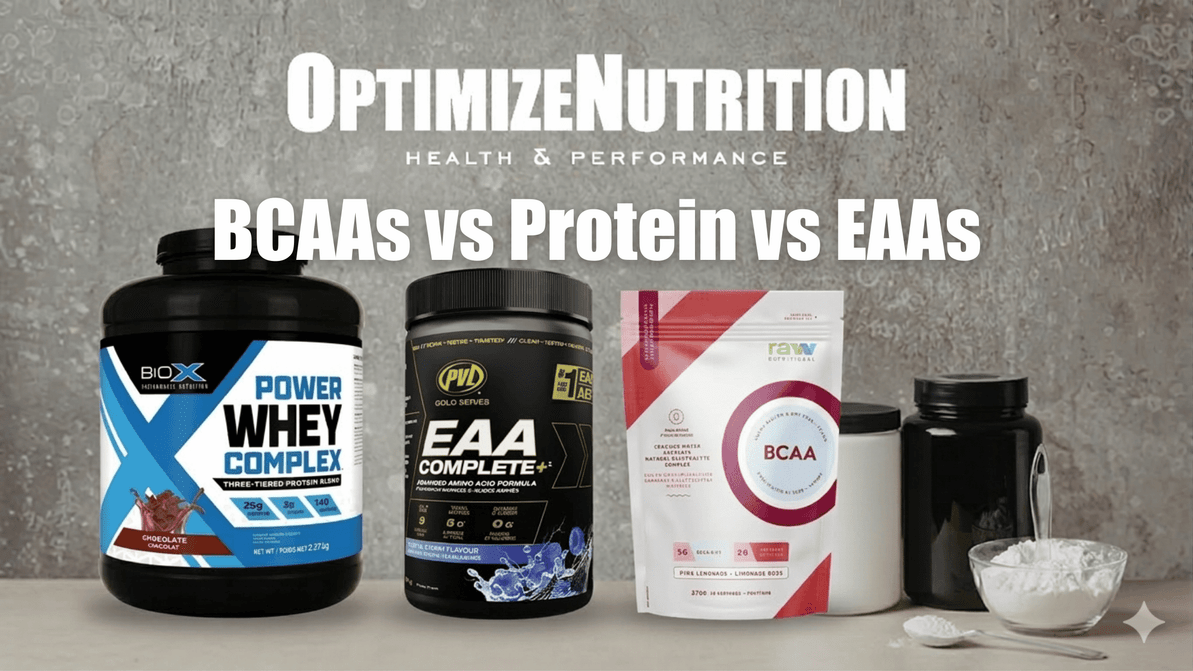
BCAAs vs Protein vs EAAs: Which Supplement Should You Actually Take?
Walk into any supplement store or browse online long enough, and you will see the same question come up again and again: should you take BCAAs, EAAs, or protein powder? With so many products promising better recovery, more muscle growth, and less soreness, it is easy to assume you need all three.
In reality, most people do not.
At Optimize Nutrition, one of the most common questions we hear is some version of: “What is better—BCAAs or protein?” The more complete answer is that EAAs also belong in the conversation, because they sit somewhere in the middle. Each option has a place, but they are not equally useful for every goal.
For most active adults, protein powder should be the foundation. It gives you complete protein, supports recovery and muscle growth, and helps you meet your daily intake more effectively than standalone amino acid supplements. EAAs can make sense in some situations, and BCAAs still have a niche, but neither should usually come before total protein intake.
Here is how these supplements compare, and how to decide what actually makes sense for your routine.
What Are BCAAs?
BCAAs, or branched-chain amino acids, are three essential amino acids:
- Leucine
- Isoleucine
- Valine
They are called branched-chain because of their chemical structure, and they are well known in the fitness world because they play a role in muscle metabolism. Leucine in particular is important because it helps signal muscle protein synthesis, which is the process your body uses to repair and build muscle tissue.
BCAAs are often marketed for:
- Supporting muscle recovery
- Reducing muscle breakdown
- Helping with workout endurance
- Decreasing soreness
These claims are part of why BCAA benefits get so much attention, especially among gym-goers training hard or dieting.
What Are EAAs?
EAAs, or essential amino acids, include the nine amino acids your body cannot produce on its own and must get from food or supplements. That includes the three BCAAs, plus six more essential amino acids your body also needs for muscle repair and recovery.
This is why EAAs are often seen as a more complete amino acid supplement than BCAAs alone. While BCAAs may help trigger muscle protein synthesis, the body still needs the other essential amino acids to actually carry out that repair and rebuilding process effectively.
In simple terms:
BCAAs are part of EAAs, but EAAs are not the same as BCAAs.
What Is Protein Powder?
Protein powder is a concentrated source of protein that usually provides a full spectrum of amino acids, including all the essential amino acids and naturally occurring BCAAs. Common types include:
- Whey protein
- Casein protein
- Beef protein
- Plant-based protein blends
Unlike isolated amino acid products, protein powder is designed to help you increase your overall daily protein intake. That matters because muscle recovery, performance, and body composition all depend heavily on getting enough total protein across the day.
This is the main reason protein powder usually wins in the BCAAs vs protein debate.
BCAAs vs EAAs vs Protein: What Is the Difference?
The easiest way to understand it is this:
BCAAs: 3 essential amino acids
EAAs: 9 essential amino acids
Protein Powder: Complete protein source that provides essential amino acids, BCAAs, and meaningful protein per serving
That means these products are not equal.
BCAAs are the most limited option.
EAAs are more complete than BCAAs.
Protein powder is usually the most practical and effective option overall.
If you are comparing BCAA vs whey protein, whey protein already contains BCAAs naturally, along with the rest of the essential amino acids your body needs. If you are comparing EAAs vs protein, EAAs may still be useful in some settings, but protein powder is usually better for meeting real-world nutrition needs.
BCAA Benefits
BCAAs are not useless, but their benefits are often exaggerated compared with how much they actually add for someone already eating enough protein.
1. They are convenient around training
BCAAs are easy to sip before or during workouts and may appeal to people who do not want a heavier shake in their stomach.
2. They may help during long training sessions
Some endurance athletes or people training for extended periods like using BCAAs in a flavoured intra-workout drink.
3. They can be useful in more specific situations
BCAAs may have more value when someone is training fasted, eating in a steep calorie deficit, or not consistently hitting protein targets.
4. They are popular for recovery support
Many people use BCAAs to help with soreness and recovery, although complete protein usually provides broader support.
The key issue is that BCAA benefits sound more impressive when taken out of context. If you are already getting enough protein from food or shakes, BCAAs are often redundant.
EAA Benefits
EAAs generally make more sense than BCAAs if someone wants an amino acid supplement.
1. More complete than BCAAs
EAAs provide all essential amino acids, not just three, which makes them more supportive of muscle repair and recovery.
2. A lighter option than protein powder
Some people want amino acid support around workouts without drinking a full shake. EAAs can fit that role.
3. Useful for training windows
For people who train early, do not tolerate protein well before workouts, or want something easy to sip during longer sessions, EAAs can be a practical middle-ground option.
4. Better amino acid-only option
If you are specifically choosing between BCAAs and EAAs, EAAs usually come out ahead because they offer a more complete amino acid profile.
Protein Powder Benefits
For most people, protein powder is still the best all-around choice.
1. Complete amino acid support
Protein powder delivers all essential amino acids and supports muscle growth, muscle repair, and overall recovery more effectively than BCAAs alone.
2. Helps you hit daily protein targets
This is one of the biggest advantages. Many people are not choosing between products in a vacuum. They are trying to recover better, build muscle, lose fat, or stay consistent with nutrition. Protein powder makes all of that easier.
3. Better for muscle growth
If your goal is to gain or maintain muscle, complete protein is usually far more useful than isolated BCAAs.
4. More satisfying
Protein powder is generally more filling than amino acid supplements, which can be especially helpful during a calorie deficit.
5. Better value
In most cases, protein powder gives you more nutritional return for your money than BCAA or EAA supplements.
BCAAs vs Protein: Which Is Better?
For most people, protein is better.
That is the straightforward answer.
Protein powder contains the BCAAs people are often looking for, but it also includes the rest of the essential amino acids needed to fully support recovery and muscle protein synthesis. In practical terms, that makes protein powder a more complete and more effective supplement for most active adults.
When someone asks about BCAAs vs protein powder, the real question is often: “Should I buy a specialized amino acid product, or should I just focus on protein?” In most cases, focusing on protein is the smarter move.
EAA vs BCAA: Which Makes More Sense?
If you want an amino acid supplement specifically, EAAs are usually the better choice.
BCAAs only provide three essential amino acids. EAAs provide all nine. Since the body needs more than just leucine, isoleucine, and valine to support muscle recovery properly, EAAs are the more complete option.
That does not automatically make EAAs better than protein powder, but it does mean EAAs usually make more sense than BCAAs for people who want a lighter amino acid formula around training.
Do You Need BCAAs?
This is where many people can simplify things.
If you already eat enough protein through food and supplements, you probably do not need BCAAs.
That includes people using whey protein, high-protein meals, Greek yogurt, eggs, meat, fish, or well-formulated plant proteins. These foods and supplements already provide BCAAs naturally.
So when people ask do you need BCAAs, the honest answer is usually no, not as a priority.
BCAAs may still be worth considering if:
- You train fasted and want something light before or during your session
- You are doing long endurance sessions
- You prefer sipping amino acids over drinking a full shake
- Your overall protein intake is not ideal
Even then, many people may be better served by EAAs or simply improving total protein intake.
When Protein Powder Makes the Most Sense
Protein powder is usually the best choice if:
- You want to build or maintain muscle
- You are trying to recover better from training
- You are dieting and want more satiety
- You struggle to hit your protein target through food alone
- You want the most versatile and cost-effective supplement option
For most people, this is the best place to start.
When EAAs Make the Most Sense
EAAs can make sense if:
- You want a lighter pre-, intra-, or post-workout option
- You do not enjoy drinking a full shake around training
- You train very early and prefer something easier on the stomach
- You want a more complete amino acid supplement than BCAAs
EAAs are not usually essential, but they can be a reasonable addition for the right person.
When BCAAs Make the Most Sense
BCAAs are most useful in narrower situations, such as:
- Fasted training
- Very long training sessions
- People who strongly prefer a simple flavoured amino drink
- Those looking for a more specific intra-workout option
Even here, they are often not the best first investment.
Which Supplement Should You Prioritize?
For most people, the ranking looks like this:
1. Protein Powder
Best overall for muscle growth, recovery, daily intake, satiety, and value.
2. EAAs
A reasonable middle-ground option if you want amino acid support without a full shake.
3. BCAAs
The most limited option, and usually the least necessary if protein intake is already adequate.
How to Use Protein, EAAs, and BCAAs
Protein Powder
A common serving is 20 to 40 grams, depending on your body size, needs, and the rest of your diet. It can be used after training, between meals, or anytime you need help reaching your daily protein goal.
EAAs
EAAs are often used before or during workouts, especially when someone wants something lighter than a shake. They can fit well around early training or longer sessions.
BCAAs
BCAAs are typically used before or during training. They are most often chosen for convenience, taste, or more niche training situations.
The bigger takeaway is that timing matters less than total daily nutrition. The best supplement routine cannot make up for not eating enough protein overall.
The Bottom Line
When comparing BCAAs vs protein vs EAAs, most people should keep it simple.
Protein powder is the best foundation. It is more complete, more versatile, and more useful for the goals most people actually care about, including recovery, muscle growth, and meeting daily protein needs.
EAAs can make sense if you want an amino acid supplement that is more complete than BCAAs but lighter than a shake.
BCAAs still have a place, but they are usually the most niche option of the three and often unnecessary when protein intake is already solid.
If you are deciding where to spend your money, focus on the basics first:
Get enough total protein.
Use protein powder if needed.
Add EAAs or BCAAs only if they truly fit your training style and goals.
FAQ: BCAAs vs Protein vs EAAs
Are BCAAs better than protein powder?
Usually no. Protein powder provides all essential amino acids and helps you meet your total protein intake, which makes it more useful for most people.
Are EAAs better than BCAAs?
In most cases, yes. EAAs contain all nine essential amino acids, while BCAAs only contain three.
Is whey protein better than BCAAs?
For most people, yes. Whey protein naturally contains BCAAs and also provides the rest of the amino acids needed for muscle recovery and growth.
Do you need BCAAs if you already drink protein shakes?
Usually not. If your protein intake is already adequate, you are likely already getting enough BCAAs.
Should you take EAAs and protein powder together?
Some people do, but it is not always necessary. Protein powder is usually the main priority, and EAAs are more of an add-on for specific situations.
Final Thoughts
In the debate of BCAAs vs protein vs EAAs, protein powder is still the best choice for most people. It is more complete, more versatile, and more effective for supporting muscle growth, recovery, and daily protein intake. EAAs can be a smart add-on in certain situations, while BCAAs are usually the most limited option and often unnecessary if your diet already includes enough protein.
Before spending more on specialty supplements, focus on the basics first: meet your daily protein needs, stay consistent with training, and choose supplements that actually support your goals. When you build on that foundation, your results tend to be much better.
Recent Posts
-

Meet Rise Nutrition: Real-Food Nutrition, Kept Simple
Meet Rise Nutrition: Real-Food Nutrition, Kept Simple We’re excited to welcome Rise Nutrition to Opt …Sep 15, 2026 -

Study Smarter This Semester: Back-to-School Tips for Focus, Memory & Mental Energy
University can be demanding on the brain. Long lectures, heavy reading loads, assignments, exams, pa …Sep 04, 2026 -

When Your Gut Isn’t the Root Problem: How Stress and the Nervous System Can Drive Digestive Symptoms
Bloating. Cramping. Constipation. Diarrhea. Nausea. Reflux. Urgency. Feeling like foods you used to …Sep 03, 2026