
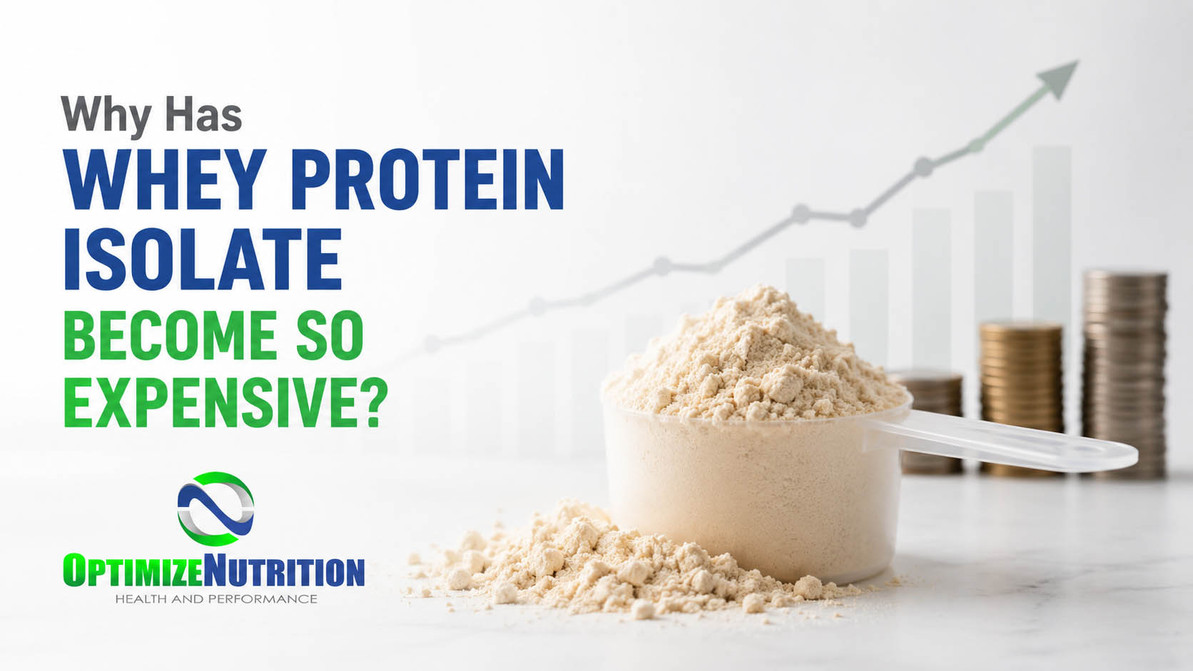
Why Whey Protein Isolate Has Become So Expensive: What’s Really Driving Prices Up
If you have purchased a tub of protein powder recently, you have probably noticed something: whey protein—especially whey protein isolate—has become significantly more expensive.
For years, protein powder prices increased relatively gradually. More recently, however, some products have jumped substantially in price, leaving customers understandably wondering what happened.
Is it inflation? Tariffs? Manufacturers raising their margins? Retailers charging more? A shortage of milk?
The answer is more complicated.
The whey protein industry is currently dealing with an unusual combination of record demand, limited production capacity, rising raw-material prices, currency pressures, processing costs and international trade issues.
Most importantly, this is not simply normal inflation.
By mid-2026, industry pricing data reported that the wholesale cost of whey protein isolate was approximately 150% higher than a year earlier, while whey protein concentrate containing around 80% protein had increased even more dramatically.
So what is actually happening?
First: Whey Isolate Is Not the Same as Regular Whey
One of the biggest misunderstandings is that all whey protein powders are essentially interchangeable.
They aren't.
Whey begins as the liquid portion separated from milk during cheese production. That liquid contains protein, lactose, minerals, water and small amounts of fat.
To make protein powder, manufacturers separate and concentrate the protein.
Whey Protein Concentrate (WPC) undergoes filtration that removes much of the water, lactose and other components.
Whey Protein Isolate (WPI) requires considerably more purification.
Industry standards define whey isolate as containing approximately 90% or more protein on a dry-matter basis. Typical isolate contains around 90–92% protein with only about 0.5–1% lactose and 0.5–1% fat. Achieving that level of purity requires additional membrane filtration and/or ion-exchange processing.
In simple terms:
More of the original whey has to be processed—and more non-protein material has to be removed—to produce whey isolate.
That makes isolate more expensive to manufacture even under normal market conditions.
When protein becomes scarce, isolate tends to become particularly vulnerable because it requires both the raw whey supply and enough specialized processing capacity to turn that whey into a 90%+ protein ingredient.
The Biggest Problem Right Now: Demand Has Exploded
Protein is no longer something consumed primarily by bodybuilders.
Over the last several years, protein has become one of the biggest trends in the entire food industry.
Protein is now being added to:
protein bars, cereals, yogurts, cottage cheese, baked goods, meal replacements, smoothies, ready-to-drink shakes, snacks, desserts and even products that historically contained very little protein.
Major dairy companies have reported strong growth in demand for high-protein foods such as skyr, cottage cheese and protein beverages.
Agriculture and Agri-Food Canada also reported that packaged foods marketed as high-protein represented approximately $1.9 billion in Canadian sales during 2025.
That means supplement companies are no longer competing only with other supplement companies for whey protein.
They are competing with enormous multinational food companies.
The same whey isolate that might previously have gone into a 5 lb tub of protein powder may now be purchased for a protein drink, yogurt, nutrition bar or fortified snack.
The GLP-1 Effect Has Added Even More Demand
Another newer factor is the enormous growth of medications such as Ozempic, Wegovy and other GLP-1 drugs.
People eating substantially fewer calories while using these medications are increasingly being encouraged to prioritize protein intake in order to help maintain lean body mass.
Food manufacturers have noticed.
This has helped create an entirely new market for convenient high-protein foods and beverages.
Even major dairy producers are now citing this trend as one of the contributors to increased protein demand.
Protein has effectively moved from a sports-nutrition category into mainstream food.
And the whey supply chain has not expanded quickly enough to keep up.
"But Isn't Whey Just a Cheap Byproduct of Cheese?"
Technically, whey originates as a co-product of cheesemaking.
But that doesn't mean whey protein isolate is cheap to produce.
Liquid whey coming out of a cheese plant is very different from the white powder found in a protein tub.
It still contains large amounts of water, lactose, minerals and other components.
Manufacturers then have to transport, filter, concentrate, purify and dry that whey.
Producing whey isolate can involve multiple filtration technologies including microfiltration, ultrafiltration and diafiltration, followed by concentration and spray drying.
Those systems require large specialized facilities, energy, membranes, equipment, labour and significant capital investment.
So while the original whey stream may begin as a product of cheese manufacturing, food-grade whey protein isolate is a highly processed and highly concentrated dairy ingredient.
That distinction matters.
You Can't Simply Make More Whey Overnight
This is another major part of the current problem.
Whey production is closely connected to cheese production.
A company can't simply decide:
"We need twice as much whey next month."
The dairy industry first needs enough milk moving through cheese plants to create the whey stream.
Then there needs to be enough specialized filtration and drying capacity available to turn that whey into protein concentrate or isolate.
Building additional dairy-processing capacity is extremely expensive and can take years.
USDA Dairy Market News was already reporting in late 2025 that manufacturers were experiencing strong demand and tight inventories for both whey protein concentrate 80% and whey protein isolate.
Those supply constraints continued into 2026.
In other words, this isn't simply a milk shortage.
It is partly a protein-processing capacity shortage.
Why Whey Isolate Has Been Hit Especially Hard
This is why customers may notice that a basic whey blend hasn't increased nearly as much as a premium isolate.
Isolate requires manufacturers to keep concentrating the whey until most of the lactose, fat and other non-protein material has been removed.
When demand for high-purity protein increases faster than filtration capacity, manufacturers can't simply turn every pound of whey into isolate.
That makes available WPI extremely valuable.
Industry data reported in mid-2026 indicated that whey protein isolate ingredient prices had increased approximately 150% year over year.
Those increases eventually work their way through manufacturers, distributors and retailers.
They don't always appear immediately because many companies purchase ingredients under contracts negotiated months in advance.
That is also why protein prices sometimes increase in large jumps rather than gradually.
A manufacturer may still be using whey purchased under an older contract.
Once that contract expires and the company has to purchase protein at the new market price, the economics of the entire product suddenly change.
Canada's Dollar Makes Imported Protein More Expensive
Canadian consumers face another problem.
Much of the international dairy-ingredient market is priced in U.S. dollars.
In 2024, one U.S. dollar averaged approximately $1.37 Canadian.
During 2025 that increased to approximately $1.40 Canadian, according to the Bank of Canada.
As of late August 2026, the exchange rate was still around $1.39 Canadian per U.S. dollar.
That difference may not sound enormous, but when a manufacturer or distributor is purchasing hundreds of thousands—or millions—of dollars worth of ingredients, even a few percentage points matters.
So a Canadian company can experience a price increase even if the U.S.-dollar price of an ingredient stays exactly the same.
When the U.S.-dollar commodity price rises dramatically at the same time, the effects compound.
What About Tariffs?
Tariffs are part of the discussion, but they are frequently oversimplified.
Canada has imposed retaliatory tariffs affecting certain U.S. whey and dairy ingredient categories, and additional tariffs affecting several whey categories are scheduled to take effect September 8, 2026.
However, it would be misleading to say that "whey isolate went up because Canada put a 50% tariff on whey isolate."
Whey products fall under different customs classifications.
For example, Canada's tariff schedule notes that products containing more than 80% whey proteins can fall under the milk-albumin classification in heading 35.02 rather than the standard whey classifications under heading 04.04.
So tariffs are not the sole explanation for whey isolate prices.
They can still affect the broader dairy ingredient market through changing trade flows, substitution and sourcing decisions, but the underlying global whey shortage and demand imbalance existed independently of tariffs.
"If Milk Prices Come Down, Shouldn't Protein Prices Come Down Too?"
Not necessarily.
This is another important misconception.
The price farmers receive for milk and the price manufacturers pay for highly concentrated whey protein are related—but they are not the same market.
In fact, in 2026 some dairy producers experienced declining milk prices while demand for high-protein dairy ingredients remained extremely strong.
Arla Foods recently reported declining milk payments while simultaneously highlighting booming demand for protein-rich dairy products.
Think of it similarly to crude oil and gasoline.
One influences the other, but refining capacity, transportation, inventories and demand for individual products can cause their prices to move very differently.
Whey isolate is experiencing its own supply-and-demand problem.
Are Protein Companies and Retailers Just Increasing Their Margins?
This is probably the most understandable assumption when a product suddenly costs $10, $20 or $30 more than it did previously.
But the current increase in whey prices is happening far upstream from the retail store.
Manufacturers are paying substantially more for whey.
Contract manufacturers are paying more.
Food companies are paying more.
Distributors are paying more.
And ultimately those costs move through the supply chain.
In fact, the wholesale ingredient increase has often been far greater than the percentage increase consumers have seen on finished protein powders.
If an ingredient rises 100–150%, that does not mean the finished tub needs to double in price because whey is only one portion of the total product cost.
But manufacturers cannot absorb increases of that magnitude indefinitely.
Eventually prices have to adjust.
Packaging, Freight and Manufacturing Haven't Gotten Cheaper Either
Whey itself is the largest story, but it isn't the only expense inside a tub of protein.
A finished protein powder also includes flavour systems, cocoa, sweeteners, enzymes or emulsifiers, containers, scoops, labels, testing, manufacturing, warehousing and transportation.
Those expenses are added after the manufacturer has already purchased the protein.
Therefore, when whey prices rise dramatically, those existing costs don't disappear.
They are layered on top.
Will Protein Prices Eventually Come Back Down?
Probably—but nobody can confidently say how quickly or how far.
High commodity prices create a powerful incentive for dairy processors to build additional filtration and drying capacity.
New facilities and expansions are already being discussed internationally.
If supply eventually catches up with demand, wholesale whey prices should ease.
But these facilities take time to construct, and global demand for protein is still growing rapidly.
There is also an important distinction between prices coming down and prices returning to where they were several years ago.
Manufacturing, labour, transportation and packaging costs have all changed permanently to some degree.
So even if whey commodity prices normalize, it would be unrealistic to assume that every tub of isolate will simply return to its old pre-2024 price.
The Bottom Line
The current increase in protein prices isn't caused by one thing.
It is the result of several pressures happening simultaneously:
global demand for protein has surged, whey processing capacity hasn't kept pace, high-purity isolate requires additional processing, inventories have tightened, Canadian companies face currency pressure, and trade uncertainty has added another layer of complexity.
Whey isolate has been affected particularly hard because it is one of the purest and most processing-intensive forms of dairy protein.
So if you're looking at the price of your favourite isolate and wondering why it suddenly costs considerably more than it used to, the answer isn't simply "inflation."
The raw ingredient itself has become dramatically more valuable.
At Optimize Nutrition, our goal remains the same: offer quality products at competitive prices while helping customers understand what they're actually paying for.
And right now, the global market for whey protein is experiencing one of the largest supply-and-demand disruptions the sports-nutrition industry has seen in years.
Recent Posts
-

Why Whey Protein Isolate Has Become So Expensive: What’s Really Driving Prices Up
If you have purchased a tub of protein powder recently, you have probably noticed something: whey pr …Sep 01, 2026 -
Product Highlight: UHTCO MacaPro XP Gold – Concentrated Maca for Energy, Stamina & Vitality
Maca has been used as a traditional food in the Peruvian Andes for centuries, but not all maca suppl …Aug 27, 2026 -
The Different Types of Magnesium—and How to Choose the Right One
Magnesium is involved in hundreds of processes throughout the body, including normal muscle and nerv …Aug 21, 2026