
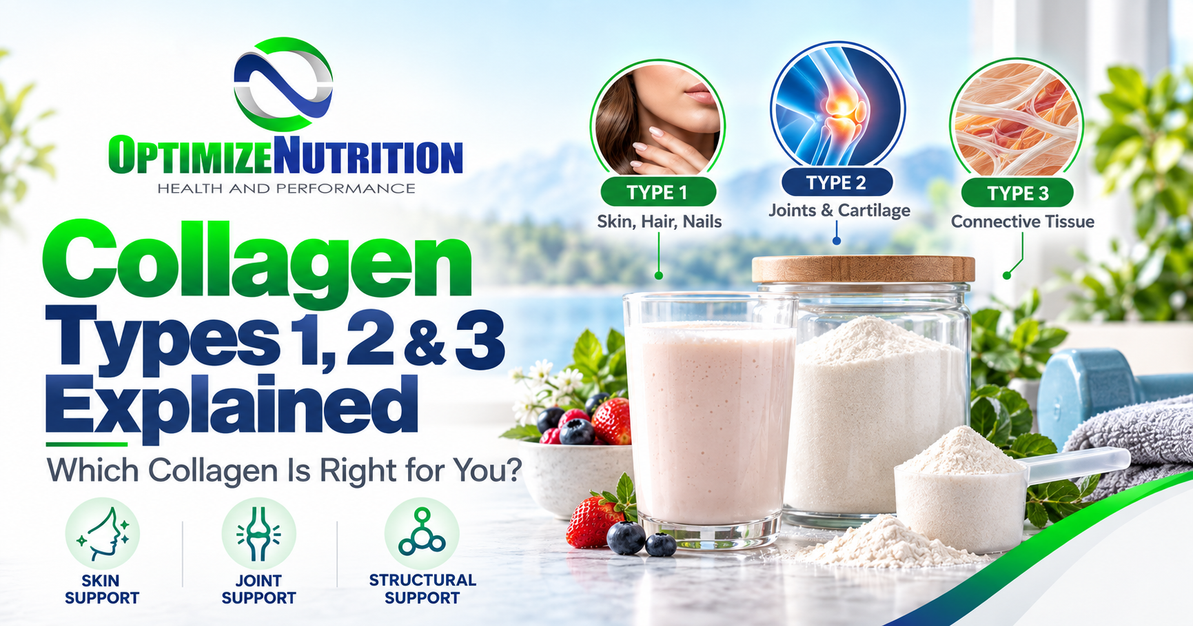
Collagen Types 1, 2 & 3 Explained: Which Collagen Is Right for You?
Collagen has become one of the most visible supplements on the market. It can now be found in powders, drinks, protein bars, creamers, gummies and products marketed for everything from skin and nails to joints and recovery.
The reality is more useful than the marketing: collagen can be a worthwhile supplement, but the form, dose and intended use matter.
Different collagen products are not interchangeable. A specialized skin peptide, a hydrolyzed collagen powder and undenatured Type II collagen may all say “collagen” on the label, but they can contain dramatically different doses and are designed for different purposes.
This guide explains the differences between collagen Types 1, 2 and 3, how hydrolyzed collagen peptides work, what research actually suggests, and several collagen options available at Optimize Nutrition in Nanaimo.
What Is Collagen?
Collagen is the most abundant structural protein in the human body. It forms part of the framework of skin, tendons, ligaments, cartilage, bone and other connective tissues.
The body produces collagen using amino acids such as glycine, proline and hydroxyproline. Collagen turnover changes with age and can also be influenced by factors such as nutrition, sun exposure and lifestyle.
Most powdered collagen supplements contain hydrolyzed collagen, also called collagen peptides. Hydrolysis breaks collagen into smaller peptide chains, allowing the powder to dissolve more easily and making it convenient to add to coffee, water, smoothies or food.
Collagen peptides are different from gelatin. Both come from collagen, but gelatin behaves differently in liquid and is more commonly used for cooking or gelling foods.
Collagen Types 1, 2 & 3: What's the Difference?
There are numerous types of collagen in the body, but Types 1, 2 and 3 receive most of the attention in supplements.
| Collagen Type | Commonly Found In | Most Relevant To |
|---|---|---|
| Type I | Skin, tendons, ligaments and bone | Skin and connective tissue support |
| Type II | Cartilage | Joint and cartilage-focused products |
| Type III | Skin, blood vessels and other connective tissues | Often paired with Type I |
Type I Collagen
Type I is the most abundant form of collagen in the human body and is particularly important in skin, tendons, ligaments and bone.
Most bovine and marine collagen powders are predominantly Type I, while bovine collagen commonly provides Types I and III together.
For someone primarily interested in skin or general connective-tissue support, hydrolyzed Type I or Type I/III collagen is one of the most common options.
Type II Collagen
Type II collagen is concentrated in cartilage and is most strongly associated with joint-focused supplements.
One important distinction is undenatured Type II collagen, often identified as UC-II®. This is not used like ordinary collagen powder.
Clinical trials have commonly studied UC-II at approximately 40 mg per day, compared with the gram-level doses used for hydrolyzed collagen peptides. A randomized controlled trial using 40 mg daily found improvements in several knee osteoarthritis measures compared with placebo over six months.
That does not mean Type II is the only collagen relevant to joints. Research has also investigated hydrolyzed Type I collagen peptides at gram-level doses for joint discomfort, mobility and tendon recovery.
Type III Collagen
Type III frequently occurs alongside Type I and is found in skin, blood vessels and other connective tissues.
Many bovine collagen supplements naturally provide both Types I and III, making this combination common in products intended for everyday connective-tissue or skin support.
Which Collagen Should You Choose?
For Skin Elasticity and Hydration
Look for a hydrolyzed collagen peptide product designed specifically for skin.
Research on oral collagen peptides suggests potential improvements in skin hydration, elasticity and barrier function. However, evidence for noticeable wrinkle reduction and major structural changes is less consistent than collagen marketing sometimes suggests.
A recent meta-analysis of 35 randomized trials found the clearest effects for hydration, elasticity and skin-barrier measures. Doses across the studies ranged from approximately 500 mg to 10 g per day, and duration appeared to be particularly important, with some effects becoming more apparent around 12 weeks.
The practical takeaway: more collagen is not automatically better. Follow the dose studied for the particular collagen peptide being used.
For Joints, Tendons and Active Recovery
There are two different approaches worth separating.
Undenatured Type II collagen, such as UC-II, is typically taken in milligram amounts and has been studied specifically for joint function and discomfort.
Hydrolyzed collagen peptides, including specialized Type I/III peptides, are taken in gram amounts and have also been researched for joints, tendons and exercise-related connective-tissue support. Reviews have included studies using approximately 5–10 g per day, depending on the formulation.
These products should not be compared simply by looking at the number of milligrams or grams on the label. They are different forms of collagen used in different ways.
For General Daily Collagen Support
A simple hydrolyzed bovine collagen containing Types I and III is a practical choice for someone who wants collagen as part of a daily nutrition routine without targeting one highly specific outcome.
Collagen should be viewed as a specialized protein source rather than a replacement for complete dietary protein. It does not have the same amino-acid profile as whey, dairy, eggs, meat or a well-formulated plant protein.
Don't Forget Vitamin C
Vitamin C plays an essential role in normal collagen synthesis because it acts as a cofactor for enzymes involved in collagen formation.
That does not necessarily mean a vitamin C supplement needs to be taken every time collagen is consumed. Someone already eating adequate vitamin C from fruits and vegetables may be getting plenty.
For those wanting collagen and vitamin C in the same formula, some products include both.
Optimize Nutrition Staff Picks
1. CanPrev Collagen Full Spectrum Powder
Best Simple Everyday Collagen
Best for: Everyday collagen supplementation, skin, connective tissue and general wellness.
Despite the “Full Spectrum” name, this product contains Type I and III hydrolyzed bovine collagen, not Types 1 through 10.
Each scoop provides 5 g of Peptiplus® Bioactive Collagen Peptides, sourced from grass-fed, pasture-raised cattle. It is unflavoured and designed to dissolve easily into coffee, smoothies or other beverages.
Why it stands out: It is a straightforward collagen formula without a long list of additional ingredients, making it easy to adjust the serving based on the intended daily intake.
2. Allmax Nutrition Collagen with Biotin & Vitamin C
Best All-in-One Skin, Hair & Nail Formula
Best for: Anyone wanting collagen combined with vitamin C and biotin in one powder.
Each serving provides:
- 10 g hydrolyzed collagen peptides
- 90 mg vitamin C
- 10,000 mcg biotin
- Types I, II and III, according to the manufacturer
The combination makes it particularly convenient for someone looking for a more comprehensive beauty-oriented formula rather than purchasing collagen, vitamin C and biotin separately.
One important note: 10,000 mcg is a high dose of biotin. Health Canada warns that high-dose biotin can interfere with certain laboratory tests, including some thyroid and cardiac-marker tests. Anyone having bloodwork should tell the healthcare provider or laboratory about biotin-containing supplements.
3. CanPrev Collagen Beauty Liquid
Best Convenient Beauty Collagen
Best for: Someone who prefers a ready-to-take liquid instead of mixing collagen powder.
Each 10 mL serving contains 2.5 g of VERISOL® Bioactive Collagen Peptides, providing hydrolyzed Types I and III bovine collagen.
The 2.5 g serving may look small next to a 10 g collagen powder, but that comparison can be misleading. VERISOL is a specific collagen peptide formulation intended to be used at a lower targeted dose.
Why it stands out: It is simple, convenient and specifically formulated around skin-focused collagen peptides, making it a practical choice for anyone unlikely to use powder consistently.
4. CanPrev Collagen Tendo Recover Powder
Best for Tendons & Active Recovery
Best for: Lifters, runners, athletes and active individuals looking for targeted connective-tissue support.
CanPrev Tendo Recover provides 5 g of TENDOFORTE® Bioactive Collagen Peptides per scoop. Importantly, the collagen is Type I and III hydrolyzed bovine collagen, rather than Type II.
The formula is specifically positioned around tendons and activity-related joint support. CanPrev's Canadian directions recommend a minimum of 12 weeks for activity-related knee-joint discomfort, emphasizing that collagen supplementation is generally a long-term strategy rather than something expected to work within a few days.
What to Look for When Buying Collagen
Check the actual collagen dose. Do not rely on the size of the container or the claims on the front label.
Look at the specific collagen form. A 40 mg undenatured Type II product cannot be directly compared with 5 g of specialized hydrolyzed peptides or 10 g of ordinary collagen powder.
Match the product to the goal. A skin-specific peptide, everyday bovine collagen and tendon-focused peptide formula may all be appropriate—but for different reasons.
Do not assume marine collagen is automatically superior. Marine collagen is an excellent option for those who prefer fish-derived collagen, but there is not strong evidence that marine collagen is universally superior to quality bovine collagen for everyone.
Give it enough time. Many collagen studies run for approximately 8–24 weeks. Consistent use matters more than expecting noticeable changes after several days.
What About Collagen in Protein Bars and Coffee Creamers?
A product containing a small amount of collagen is not necessarily useless, but the dose needs context.
For example, 2.5 g of a specific researched collagen peptide is very different from adding an unspecified 2 g of generic collagen to a coffee creamer and marketing it as a beauty product.
Always compare the type, form, dose and intended use, not just the word “collagen” on the front of the package.
Collagen Supplements and Canadian Regulation
Natural health products sold in Canada must be authorized before sale and carry an eight-digit Natural Product Number (NPN). Health Canada advises consumers to look for a valid NPN or DIN-HM when purchasing a natural health product.
An NPN is useful because it confirms that the product has been authorized for sale in Canada as a natural health product. It should not, however, be interpreted as proof that every marketing statement made about collagen applies equally to every formulation.
The Bottom Line
Collagen is better viewed as a targeted nutrition tool than a miracle beauty powder.
For skin, hydrolyzed Types I and III and skin-specific bioactive peptides are common options. For joint health, both undenatured Type II collagen and specialized hydrolyzed collagen peptides have been studied—but they use very different doses and mechanisms. For everyday use, a simple hydrolyzed Type I/III bovine collagen is an easy place to start.
The most important factors are choosing the right formulation, using the appropriate dose and taking it consistently long enough to evaluate the result.
Collagen products are available in-store at Optimize Nutrition in Nanaimo and online across Canada.
FAQ
What are collagen Types 1, 2 and 3?
Type I is found extensively in skin, bone, tendons and ligaments. Type II is concentrated in cartilage. Type III commonly occurs alongside Type I in skin and other connective tissues.
Which collagen is best for skin?
Hydrolyzed Type I or Type I/III collagen is commonly used for skin. Specialized bioactive peptides such as VERISOL® have also been studied at relatively low doses. Research is strongest for improvements in skin hydration and elasticity, while evidence for wrinkle reduction is less consistent.
Which collagen is best for joints?
There is no single answer. Undenatured Type II collagen has been studied at approximately 40 mg daily, while hydrolyzed Type I collagen peptides and specialized tendon/joint peptides are generally used in gram-level doses.
What does “10 g of collagen peptides” mean?
It means the serving contains approximately 10 grams of hydrolyzed collagen protein that has been broken into smaller peptide chains.
Is more collagen always better?
No. The appropriate dose depends on the particular peptide and intended use. Studies of skin-focused products have used doses from below 1 g to 10 g daily, while specialized products can be effective at doses quite different from standard collagen powder.
Do collagen supplements need vitamin C?
Vitamin C is required for normal collagen synthesis, but it does not necessarily need to be taken in the same scoop. Maintaining adequate vitamin C intake through diet or supplementation is the important factor.
How long does collagen take to work?
That depends on the goal and formula. Skin studies commonly run for roughly 8–16 weeks, while joint and connective-tissue studies often use 12 weeks or longer.
Recent Posts
-

Collagen Types 1, 2 & 3 Explained: Which Collagen Is Right for You?
Collagen has become one of the most visible supplements on the market. It can now be found in powder …Sep 23, 2026 -

The Best Pre-Workouts in Canada: An Honest Guide to Stim vs. Stim-Free
Walk into almost any supplement store and the pre-workout section can be overwhelming: tubs promisin …Sep 21, 2026 -

Meet Rise Nutrition: Real-Food Nutrition, Kept Simple
Meet Rise Nutrition: Real-Food Nutrition, Kept Simple We’re excited to welcome Rise Nutrition to Opt …Sep 15, 2026