
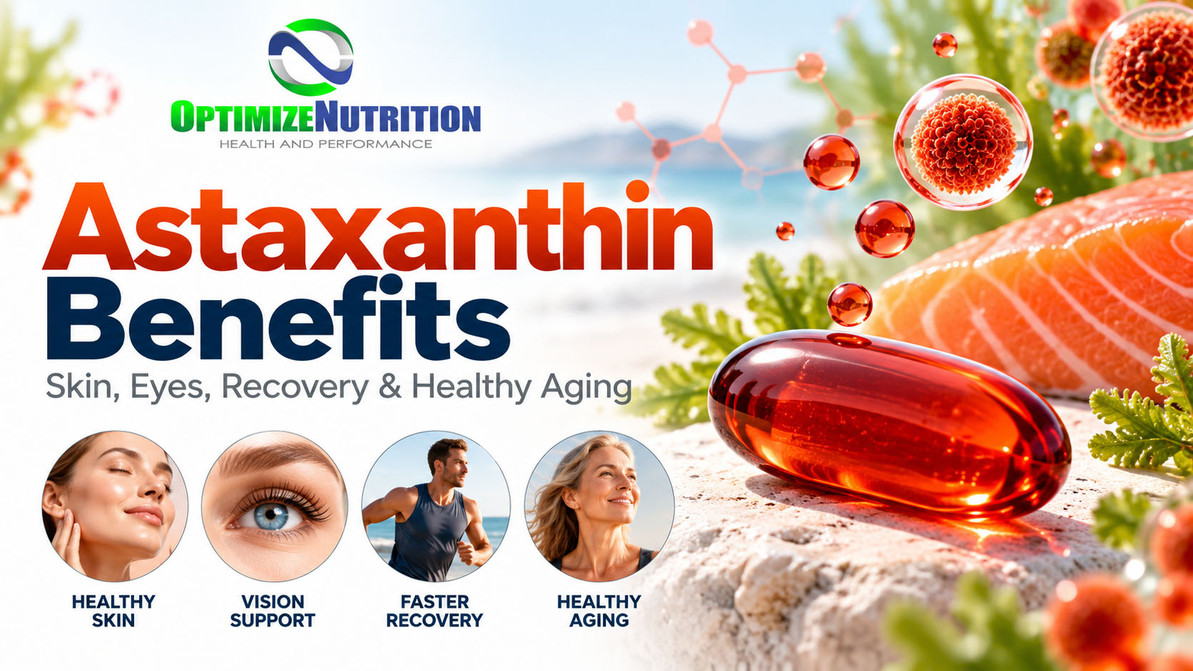
Astaxanthin Benefits: The Antioxidant for Skin, Eyes, Recovery & Healthy Aging **Draft
Astaxanthin has quietly become one of the most talked-about antioxidants in the supplement world. Unlike many compounds that suddenly become popular because of social media hype, astaxanthin has been studied in humans for skin health, eye health, exercise recovery, oxidative stress and several aspects of healthy aging.
So what exactly is astaxanthin, and does the research justify the attention?
What Is Astaxanthin?
Astaxanthin is a naturally occurring carotenoid, part of the same broad family of plant pigments as beta-carotene, lutein and zeaxanthin.
It is responsible for much of the reddish-pink colour found in foods such as:
- Salmon
- Trout
- Krill
- Shrimp
- Crayfish
- Other red or pink seafood
These animals do not generally produce astaxanthin themselves. Instead, it enters the food chain primarily through algae and microorganisms.
One of the most common natural sources used in supplements is the microalgae Haematococcus pluvialis, which can accumulate particularly high concentrations of astaxanthin.
Astaxanthin's unusual molecular structure allows it to interact with both the inner and outer portions of lipid membranes. This is one reason researchers have become interested in its ability to influence oxidative stress and inflammatory signalling. PubMed
Why Are Antioxidants Important?
Oxidation is a normal part of metabolism.
Exercise, immune activity, energy production and even simply breathing create reactive molecules commonly referred to as reactive oxygen species, or ROS.
That is not automatically a bad thing. Some oxidative stress is necessary for normal cellular signalling and exercise adaptation.
Problems can develop when the production of reactive molecules consistently exceeds the body's antioxidant defence systems.
This imbalance is called oxidative stress.
Astaxanthin appears to interact with several antioxidant and inflammatory pathways rather than simply acting as a molecule that indiscriminately "eliminates free radicals." Recent human research has reported changes in markers of antioxidant capacity, oxidative stress and inflammatory signalling following supplementation. PubMed
That distinction matters because the old idea that "more antioxidants are always better" is far too simplistic.
Potential Benefits of Astaxanthin
1. Skin Health and Healthy Aging
Skin health may be one of the more interesting applications of astaxanthin.
Skin is continually exposed to oxidative stress from:
- UV radiation
- Air pollution
- Environmental stressors
- Normal aging
- Lifestyle factors
Clinical research has examined astaxanthin for skin moisture, elasticity, wrinkles and UV-related skin damage.
A systematic review and meta-analysis of controlled trials found oral astaxanthin supplementation was associated with improvements in skin moisture and elasticity, although the reduction in wrinkle depth did not reach statistical significance compared with placebo. PubMed
Another review of clinical trials reported potential improvements in skin texture, moisture and appearance, while also noting an important limitation: many of the studies have been relatively small and some were commercially funded. PubMed
So while astaxanthin should not be treated as an oral sunscreen or miracle anti-aging supplement, the skin-health research is promising.
Where it may fit
Astaxanthin may be particularly interesting alongside the basics of healthy skin:
Astaxanthin + omega-3s + adequate protein + vitamin C + collagen-supportive nutrition + sun protection
Supplements can support the foundation, but they cannot replace sunscreen, adequate nutrition and healthy lifestyle habits.
2. Eye Health and Screen Fatigue
Astaxanthin also has an interesting relationship with eye health.
This makes sense considering that other carotenoids — particularly lutein and zeaxanthin — are already well known for their roles in the eye.
Research has investigated astaxanthin for:
- Eye fatigue
- Visual accommodation
- Screen-related eye strain
- Tear production
- Visual function
A 2025 randomized, double-blind trial involving children who spent at least four hours per day using digital screens found that 4 mg of astaxanthin daily for 84 days improved several measures of digital eye strain compared with placebo, although not every measured eye-health outcome improved. PubMed
Earlier human studies have also explored astaxanthin for visual fatigue and eye accommodation.
This does not mean astaxanthin corrects vision problems. Rather, it may have a role as part of a broader nutritional strategy for people experiencing significant visual stress from computers, phones and screens.
Optimize Nutrition also carries eye-health formulas combining astaxanthin with nutrients such as lutein and zeaxanthin, which may make sense for people looking for broader carotenoid support. Optimize Nutrition
3. Exercise Recovery
This may be one of the most interesting emerging areas of astaxanthin research.
Hard exercise temporarily increases oxidative stress, inflammation and muscle damage. Researchers have therefore investigated whether astaxanthin could influence recovery.
A 2026 systematic review and meta-analysis of 24 randomized controlled trials found astaxanthin supplementation significantly reduced the muscle-damage marker creatine kinase (CK). Lactate dehydrogenase also decreased, although the researchers cautioned that there was considerable variability between studies. PubMed
However, there is an important distinction:
Recovery does not necessarily equal performance.
The same analysis found no significant improvement in VO₂ max, time-trial performance or maximal power/workload.
That means astaxanthin currently makes more sense to think about as a potential recovery-support nutrient than as something that will directly make you stronger or faster.
That is a much more realistic interpretation of the evidence.
4. Oxidative Stress and Inflammation
This is probably astaxanthin's broadest area of research.
A 2026 systematic review examining human trials published from 2020–2025 found astaxanthin supplementation was associated with reductions in several inflammatory and oxidative-stress markers while increasing measures of antioxidant defence. PubMed
This has led researchers to investigate astaxanthin across many different areas of health.
However, it is important not to make the jump from:
"Astaxanthin influences inflammation pathways"
to:
"Astaxanthin treats inflammatory disease."
Those are very different claims.
Most of the evidence currently supports astaxanthin as a nutritional antioxidant, while many disease-specific applications remain experimental.
5. Cardiovascular and Metabolic Health
Astaxanthin is also being researched for its potential influence on:
- Blood vessel function
- Lipid metabolism
- Oxidative stress
- Glucose metabolism
- Inflammatory signalling
Some human studies have reported changes in cardiovascular and metabolic markers, although results have not been consistent enough to consider astaxanthin a treatment for cardiovascular or metabolic disease.
One small study using 12 mg daily for four weeks in people with overweight or obesity found changes in carbohydrate oxidation during exercise, but did not find significant improvements in fat oxidation, blood glucose, lactate or perceived exertion. PubMed
This is a good example of why supplement research needs context.
Interesting biological effects do not automatically translate into dramatic real-world changes.
For cardiovascular health, nutrition, exercise, sleep, blood pressure management, healthy body composition and adequate omega-3 intake remain much more important foundations.
6. Brain Health and Cognition
Astaxanthin can also interact with biological pathways involved in nervous-system health, which has led to growing interest in its potential effects on:
- Cognitive function
- Mental fatigue
- Neuroinflammation
- Healthy brain aging
There are human trials in this area, but the research is still much smaller than the evidence surrounding nutrients such as creatine or omega-3 fatty acids.
A 2024 meta-analysis examined randomized trials investigating astaxanthin for fatigue, cognitive function and exercise efficiency, reflecting the growing research interest in these applications. PubMed
For now, brain health should probably be viewed as a promising but developing area of research rather than one of the primary reasons to supplement astaxanthin.
How Much Astaxanthin Is Typically Used?
There is no single universally established astaxanthin dose for every purpose.
Human studies commonly use doses somewhere around:
4–12 mg per day
although some clinical research has used higher amounts.
The 2026 exercise meta-analysis included trials using approximately 4–28 mg per day, depending on the study design and purpose. PubMed
Higher does not automatically mean better.
The appropriate amount depends on the product, intended use and individual.
Take Astaxanthin With Food
Astaxanthin is fat soluble.
That means taking it with a meal containing some dietary fat may improve absorption.
Human pharmacokinetic research has demonstrated substantially greater astaxanthin bioavailability when consumed in lipid-based formulations or around a meal compared with less favourable conditions. PubMed
A meal containing foods such as eggs, olive oil, avocado, nuts, seeds or fatty fish would therefore generally make more sense than taking astaxanthin on an empty stomach.
Natural vs Synthetic Astaxanthin
Astaxanthin can come from several sources.
Most natural astaxanthin supplements use algae, commonly Haematococcus pluvialis, whereas synthetic astaxanthin is also produced commercially.
The molecular forms and ratios of astaxanthin can differ depending on the source.
For consumers, the more practical questions are usually:
- How much astaxanthin does the product actually provide?
- What is the source?
- Is the manufacturer reputable?
- Is the product protected from excessive heat, oxygen and light?
- Does the product have appropriate quality testing?
- Is the dose suitable for the intended purpose?
Because astaxanthin is both fat soluble and relatively sensitive to degradation, formulation quality matters. PubMed
Astaxanthin vs Other Antioxidants
Astaxanthin is sometimes marketed using dramatic claims such as being "thousands of times stronger" than another antioxidant.
Those comparisons usually come from laboratory antioxidant assays, not head-to-head human clinical outcomes.
They should therefore be interpreted cautiously.
Vitamin C, vitamin E, glutathione, carotenoids and polyphenols all behave differently in the body.
Rather than asking:
"What is the strongest antioxidant?"
A better question is:
"Which nutrients support the biological system or goal I'm interested in?"
For example:
- Astaxanthin: skin, eye and emerging recovery research
- Lutein + zeaxanthin: particularly relevant to eye health
- Vitamin C: collagen formation and water-soluble antioxidant activity
- Vitamin E: lipid-soluble antioxidant protection
- NAC: precursor for glutathione production
- Omega-3s: cell membranes and healthy inflammatory signalling
They are not interchangeable.
Who Might Be Interested in Astaxanthin?
Astaxanthin may be worth considering for adults primarily interested in:
Skin health and healthy aging
Especially alongside collagen-supportive nutrition and sun protection.
Eye health and heavy screen use
Particularly when combined with other eye-supportive carotenoids such as lutein and zeaxanthin.
Exercise recovery
Current evidence appears more promising for recovery markers than direct improvements in athletic performance.
Antioxidant support
For someone looking to add another carotenoid antioxidant to an already well-balanced diet.
An Astaxanthin Option at Optimize Nutrition
Optimize Nutrition currently carries Provita Astaxanthin Forte, providing 15mg of astaxanthin per vegetarian capsule and manufactured in Canada.
Because this is a higher-potency option compared with the doses used in some clinical studies, follow the product directions rather than assuming that more astaxanthin will necessarily provide greater benefits.
Astaxanthin is also found as part of some combination formulas in the store, including targeted eye-health and omega-3 products.
The Bottom Line
Astaxanthin is more than another trendy antioxidant.
Human research suggests potential benefits for skin moisture and elasticity, eye and screen-related visual comfort, antioxidant defence and exercise recovery. Research into cardiovascular, metabolic and brain health is also developing.
At the same time, astaxanthin should not be treated as a cure-all.
The most convincing approach is to use it for a specific purpose, alongside the basic foundations that matter far more: quality nutrition, exercise, sleep, adequate protein, omega-3 fats, fruits and vegetables, and sensible sun protection.
As research continues, astaxanthin is likely to remain one of the more interesting carotenoids to watch.
Recent Posts
-
Astaxanthin Benefits: The Antioxidant for Skin, Eyes, Recovery & Healthy Aging **Draft
Astaxanthin has quietly become one of the most talked-about antioxidants in the supplement world. Un …Oct 02, 2026 -

Best Natural Supplements for Better Sleep (Beyond Melatonin)
Melatonin gets most of the attention when people look for sleep support, but it is not the only opti …Oct 01, 2026 -

Best Greens Powders in Canada: 4 Staff Picks for Different Goals
Greens powders can be a convenient way to increase the variety of plant-based nutrients in a daily r …Sep 25, 2026